Golden Retriever Food: What Changes From Puppy to Senior
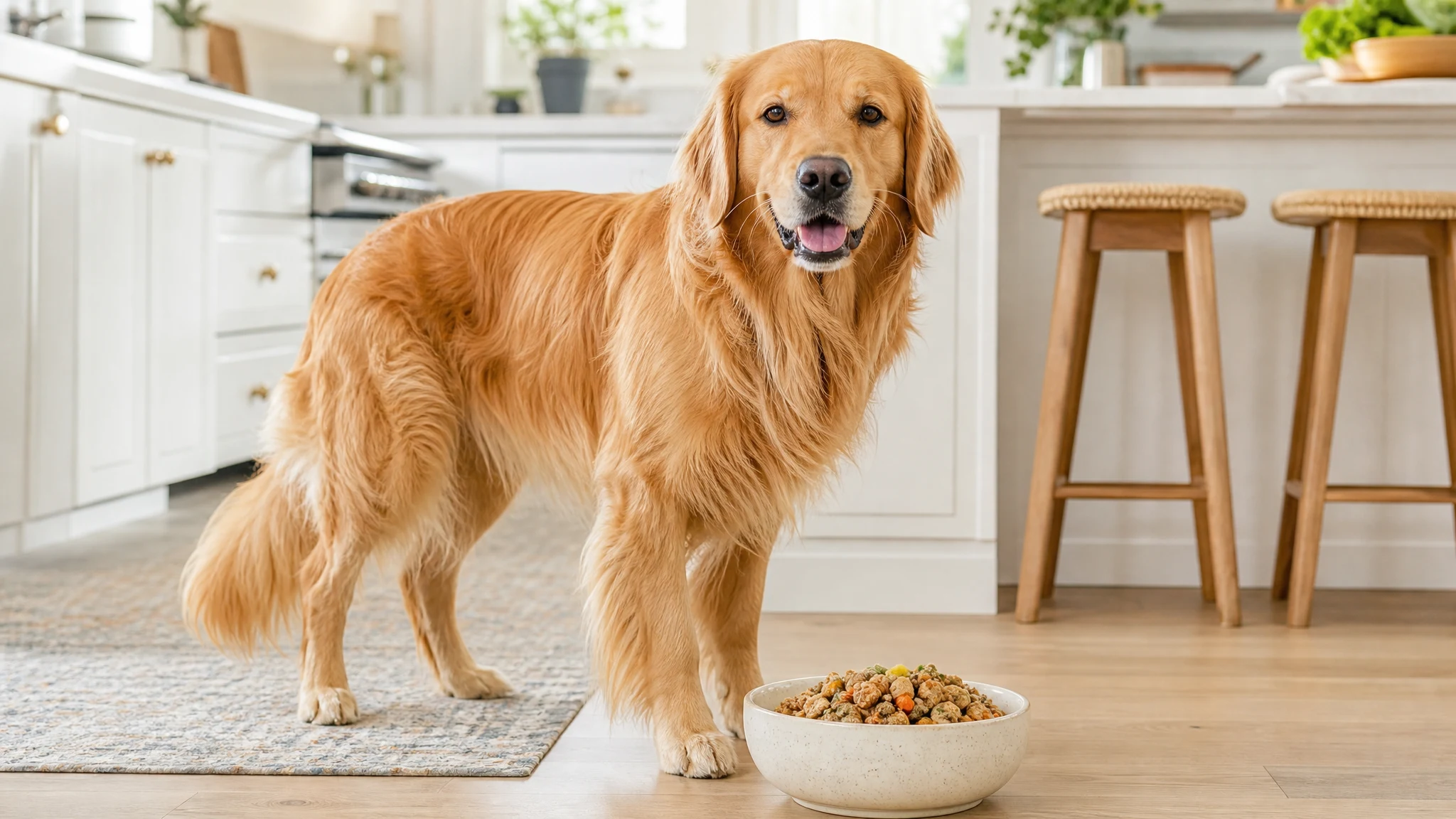
General nutrition information compiled from product labels and published sources, not veterinary advice. Your veterinarian is the right person to choose a diet for your dog, especially one with a health condition.
Golden Retriever food is not one product for life. The right label, calorie level and feeding plan shift as a dog grows, settles into adulthood and slows down. This guide walks through each stage as a set of steps, so you can read labels with a clear head and ignore most of the marketing.
One note on method: we compared label data only. We did not run feeding trials or taste tests, and nothing here says a food will prevent or treat a health problem. Your veterinarian decides what is right for your individual dog.
What You Need Before You Start
- The current food bag or can, so you can read the nutritional adequacy statement.
- Your dog's current weight and a kitchen scale or a standard measuring cup.
- A notebook or phone note for weight, treats and stool quality.
- Your veterinarian's contact details, since every stage change is worth a quick check-in.
- Patience. Each change in food works best when it is gradual.
Step 1: Know the Size You Are Feeding For
The AKC breed page lists adult males at 65 to 75 pounds and females at 55 to 65 pounds. Royal Canin describes Goldens as a large breed. Many Goldens end up at or above the 70 pound line that pet food rules use for "large size" growth, so large-breed puppy nutrition matters.
The AKC gives a life expectancy of 10 to 12 years, so a Golden may spend a good share of life as an adult and a senior. Plan for the long run, not just the puppy months.
Step 2: Choose a Puppy Food That Names Large-Size Growth
Start with the nutritional adequacy statement, usually in small print near the ingredient list. Under the Kentucky Agricultural Experiment Station's rule (12 KAR 3:039), which uses the AAFCO model wording, a food that claims "growth" or "All Life Stages" must add one of two phrases:
- "including growth of large size dogs (70 lb. or more as an adult)", or
- "except for growth of large size dogs (70 lb. or more as an adult)".
For a Golden puppy, the first phrase is the one to look for. The second means the food is not formulated to the large-size growth levels.
Cornell University's Riney Canine Health Center advises feeding diets formulated for large breeds while growing, avoiding overfeeding fast-growing large-breed puppies, and not adding calcium or vitamin D supplements to a growing puppy's diet. Cornell also notes that hip dysplasia is genetic but modified by nutrition and growth rate. That is why a lean, steady puppy is the goal, not a chubby one.
Here is how the puppy foods we have label data for look:
- Royal Canin Golden Retriever Puppy (dry): for purebred Goldens from 8 weeks to 15 months. First ingredients: chicken by-product meal, corn, chicken fat, wheat, brewers rice. Minimum protein 27%, minimum fat 14%, 339 kcal per cup. We could not find an AAFCO adequacy statement on the brand's page, so check the bag or ask Royal Canin.
- Hill's Science Diet Puppy Large Breed Chicken & Brown Rice: for large-breed puppies up to 18 months. The statement says feeding tests substantiate complete and balanced nutrition for growing puppies. The wording we have does not include the large-size phrase, so confirm it on your bag. Dry-matter averages are 26.3% protein and 15.4% fat, with 391 kcal per cup.
- JustFoodForDogs Chicken & Rice (fresh frozen): formulated for all life stages, including growth of large size dogs (70 lbs. or more as an adult). As-fed minimums are 8% protein and 3% fat because of the high moisture.
Step 3: Feed Measured Amounts and Keep the Puppy Trim
Use the feeding guide on the bag as a starting point, not a rule. Royal Canin suggests splitting the day's food into 2 to 4 equal portions. Hill's tells you to adjust amounts to maintain optimal weight and to ask your veterinarian if unsure.
Check your puppy's body shape every week or two. Cornell's advice for puppies at higher orthopedic risk is to keep them trim while they grow, without cutting essential nutrients. Do not cut portions on your own beyond the guide. Ask your veterinarian to judge body condition.
Step 4: Switch to Adult Food at the Right Time
There is no single age that every source agrees on. Royal Canin moves Goldens to its adult formula at 15 months. Hill's labels its large-breed puppy food for puppies up to 18 months. These are manufacturer guidelines, so ask your veterinarian when your dog is ready.
When you switch, mix the new food into the old over about a week or more. Raise the new share a little every day or two. If stools get loose, slow down.
Step 5: Compare Adult Labels Carefully
Adult food should carry a statement for maintenance, or for all life stages. Here is what the labels show:
| Food | Stage | Adequacy statement | Calories | Protein / fat | First ingredients |
|---|---|---|---|---|---|
| Royal Canin Golden Retriever Adult (dry) | Adult, 15 months and older | Not found on brand page; check the bag | 278 kcal ME per cup | Min 23% / min 11% | Corn, chicken by-product meal, wheat, oat groats, brewers rice |
| Hill's Science Diet Adult Large Breed Chicken & Barley (dry) | Adult large breed, 1 to 5 years | Feeding tests, maintenance | 365 kcal per cup | Dry-matter average 23.8% / 15% | Chicken, cracked pearled barley, brown rice, brewers rice, whole grain wheat |
| Hill's Science Diet Adult 6+ Large Breed Chicken Meal, Barley & Rice (dry) | Large breed, 6 and older | Feeding tests, maintenance | 352 kcal per cup | Dry-matter average 18.7% / 13.5% | Chicken meal, cracked pearled barley, brewers rice, whole grain wheat, whole grain corn |
Be careful with the protein and fat columns. Royal Canin lists guaranteed minimums as fed. Hill's publishes dry-matter averages. Those are different measures, so do not treat the numbers as a head-to-head score. For a wider view, see our Golden Retriever foods compared by label.
Step 6: Watch Calories in Adulthood
The AKC notes that some Goldens can become overweight and that owners should watch calories. Count treats, chews and training rewards as food. Weigh the dog monthly and write it down.
Calories per cup vary a lot between foods. Using the table, Royal Canin's adult formula has 278 kcal per cup, while Hill's adult large breed has 365. Swapping foods cup for cup could change daily calories by a large amount. Recalculate the portion from the new label each time.
Step 7: Adjust for the Senior Years
There is no universal start date for "senior." Hill's labels one large-breed formula for dogs 6 and older with an ideal weight of 55 to 110 pounds. Its label data show fewer calories (352 kcal per cup against 365) and a lower average dry-matter protein than its adult version.
Do not assume an older Golden needs less food or less protein. That is a decision to make with your veterinarian, who can look at body condition, kidneys, joints and appetite. The AKC lists hip and elbow dysplasia, eye disease and cardiac disease among Golden health concerns. A food label cannot treat any of them. Prescription diets are something only a veterinarian prescribes.
A Note on Heart Health and Grain-Free Diets
The Golden Retriever Club of America says Goldens appear particularly susceptible to taurine deficiency in diet-associated heart disease. The FDA says Goldens may be genetically predisposed to taurine deficiency, and also notes a reporting bias for the breed in DCM reports.
The FDA received 1,382 DCM reports between January 1, 2014 and November 1, 2022. It says reports involve both grain-free and grain-containing diets, and most involve diets listing peas, lentils or other pulses high in the ingredient list. It also says report counts alone do not establish a cause, and that it has not requested recalls. Its page was last updated December 23, 2022, and the agency said it would not release further public updates without meaningful new science.
The practical takeaway is modest: ask your veterinarian about heart health, especially before choosing an unusual or boutique diet.
Tips and Common Mistakes
- Mistake: adult food too early or too late. Follow the age the brand gives, then confirm with your veterinarian.
- Mistake: adding calcium or vitamin D to a puppy's bowl. Cornell advises against supplementing growing puppies with these.
- Mistake: trusting the front of the bag. The statement in small print tells you what the food is formulated for.
- Mistake: comparing numbers on different bases. As-fed and dry-matter figures cannot be compared directly.
- Tip: keep the old bag's label or take a photo before you switch. It helps when talking with your veterinarian.
- Tip: change only one thing at a time, either the food or the treats.
What to Expect
With a well-matched food, measured portions and gradual changes, many owners see steady growth in a puppy, a stable weight in an adult and firm stools. A food suited to the life stage may help support these goals, but results vary by dog and are not guaranteed. If you see itching, ongoing loose stools, weight loss, weight gain or low energy, call your veterinarian rather than switching foods repeatedly.
For brand details, go to the manufacturer's own pages: Royal Canin Golden Retriever Adult, Royal Canin Golden Retriever Puppy, Hill's Puppy Large Breed, Hill's Adult Large Breed and Hill's Adult 6+ Large Breed. Formulas change, so check current labels.
Sources
- American Kennel Club, Golden Retriever breed page
- Cornell University College of Veterinary Medicine, Canine hip dysplasia
- Cornell University College of Veterinary Medicine, Elbow dysplasia
- Golden Retriever Club of America, Diet-Associated Heart Disease in Golden Retrievers
- U.S. FDA, Investigation into Potential Link between Certain Diets and Canine DCM
- U.S. FDA, Questions & Answers on Non-Hereditary DCM in Dogs
- Kentucky Agricultural Experiment Station, 12 KAR 3:039 Nutritional adequacy