Golden Retriever Feeding Chart by Weight: How Much to Feed
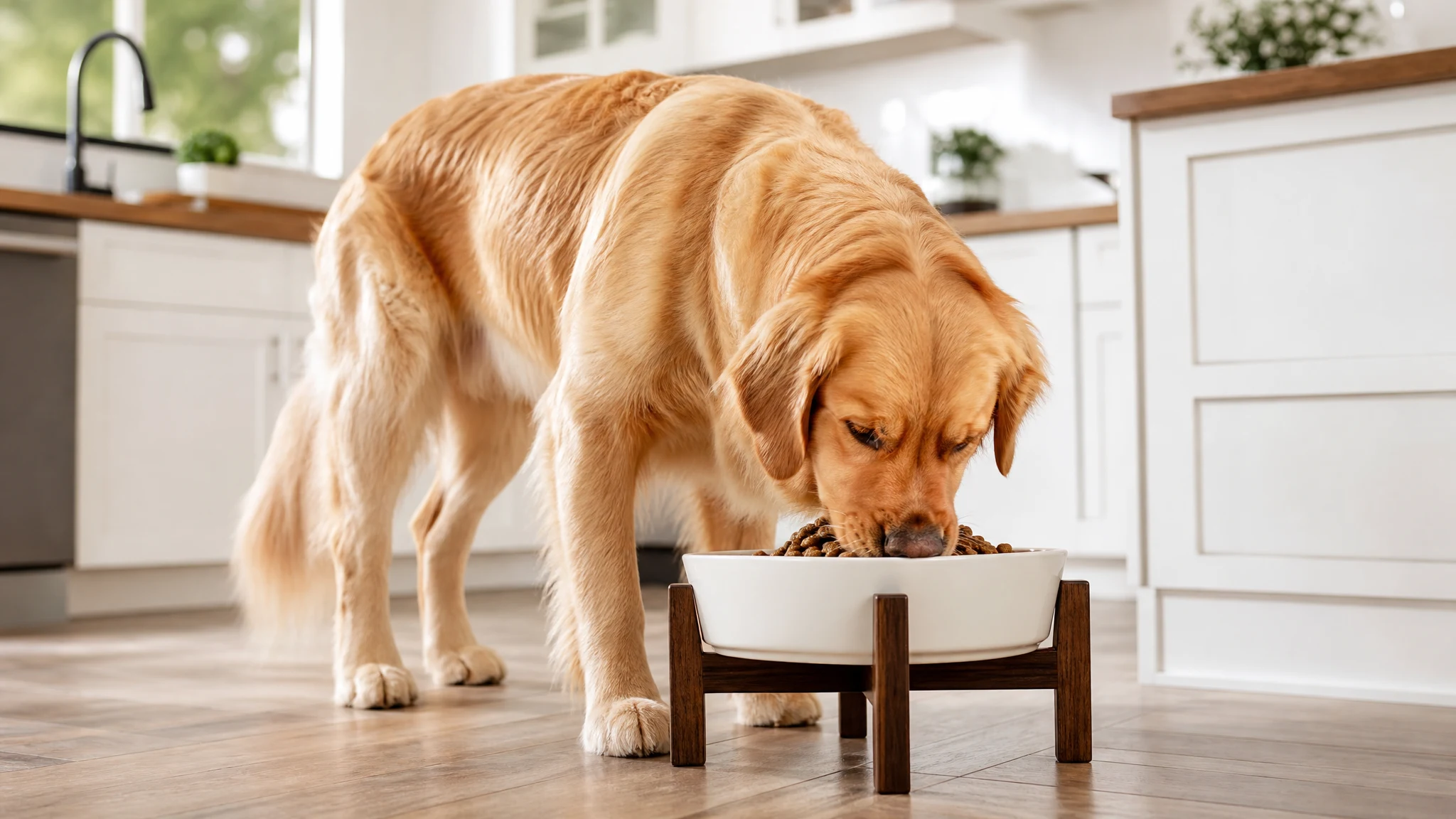
General nutrition information compiled from product labels and published sources, not veterinary advice. Your veterinarian is the right person to choose a diet for your dog, especially one with a health condition.
Most owners want one simple number: how many cups a day. The honest answer is that a label gives a starting point, and your dog's body decides the rest. This guide shows how to use a golden retriever feeding chart by weight, what the labels actually say, and how to adjust from there.
We compared label data from the brands' own pages. We did not run feeding trials or taste tests, and nothing here replaces your veterinarian's advice.
What you need before you start
- The bag, can or tray of the food you actually feed, with its feeding guide and calorie statement.
- A standard dry measuring cup or a kitchen scale. Scoops that come free in the bag vary, so check them against a real cup.
- A way to weigh your dog, such as a vet visit or a home scale.
- A notebook or phone note to track weight, portions and treats.
- Your veterinarian's number, for any dog with a health condition.
Step 1: Know the size you are feeding
The AKC breed page lists adult males at 65 to 75 pounds and adult females at 55 to 65 pounds. It also lists a typical life expectancy of 10 to 12 years. Royal Canin describes Goldens as a large breed, which matters because large-breed foods are built around slower growth and a lower risk of excess weight.
Your own dog may fall outside those ranges. Frame, muscle and body condition matter more than a number on a chart.
Step 2: Pick the right life stage
Puppy and adult foods are not interchangeable. Manufacturers draw the line at different ages. Royal Canin feeds its Golden Retriever puppy formula up to 15 months and the adult formula from 15 months. Hill's labels its large-breed puppy food for dogs that will weigh over 55 pounds as adults, up to 18 months.
For a breakdown of portions at each stage, see our Golden Retriever feeding chart by age.
Check the nutritional adequacy statement on any puppy food. Under the model wording used in state feed rules such as Kentucky's 12 KAR 3:039, a food that claims growth or all life stages must say either 'including growth of large size dogs (70 lb. or more as an adult)' or 'except for growth of large size dogs (70 lb. or more as an adult)'. Because many male Goldens reach or pass 70 pounds, the 'including' wording is the one to look for.
Step 3: Read the label's feeding guide
Every label guide is a starting point for an average dog. Here is what the brand pages say for a 60 pound dog, which sits at the top of the AKC female range. Amounts are per day.
| Food (brand page) | Form | Label guide for a 60 lb dog | Calories on label |
|---|---|---|---|
| Hill's Science Diet Adult Large Breed Chicken & Barley | Dry | 3 2/3 cups | 365 kcal per cup |
| Hill's Science Diet Adult 6+ Large Breed Chicken Meal, Barley & Rice | Dry | 3 1/3 cups | 352 kcal per cup |
| Hill's Science Diet Adult Beef & Barley Entree | Wet | 3 2/3 cans (13 oz) | 363 kcal per 13 oz can |
| Hill's Science Diet Adult Chicken & Brown Rice Fresh Roll | Fresh | 25 oz | Not listed on the page |
| Royal Canin Golden Retriever Adult | Dry | Divide into 2 to 4 equal portions; see the brand's table for amounts | 278 kcal per cup |
Notice how much the numbers differ. A cup of one food is not a cup of another. That is why calories per cup matter more than cups alone.
For a dog of a different weight, open the brand page linked in the sources and read its full feeding table. We have not listed amounts we cannot source. For Hill's large-breed puppy food, the page says to adjust amounts to maintain optimal weight and to ask your veterinarian if unsure.
Step 4: Split the day into meals
Royal Canin's Golden Retriever pages recommend feeding 2 to 4 equal portions per day. For most adult households, two meals is the practical choice. Puppies usually do better with more, smaller meals, and your veterinarian can tell you how many.
Divide the daily total from Step 3 by the number of meals. Measure each one. Do not eyeball it.
Step 5: Adjust for age and activity
The label assumes an average adult. A Golden that swims, hikes or works in the field may need more. A calm house dog, a senior or a neutered dog may need less. Brands such as Hill's publish a separate large-breed 6+ food with slightly fewer calories per cup, which is one sign that needs shift with age.
Change amounts slowly. A small adjustment, held for a couple of weeks while you watch the scale and the dog's shape, tells you more than a big swing.
Step 6: Count treats and extras
Treats, chews, training rewards and table scraps all add calories. The AKC notes that some Goldens can become overweight, so it pays to watch the total. If you use many treats for reward-based training, take a little out of the meal to balance it.
Step 7: Check body condition every two weeks
Run your hands along the ribs. You should feel them under a thin layer of padding, without pressing hard. Look from above for a visible waist. If either is missing, trim the portion slightly. If the ribs are sharp and easy to see, increase slightly or ask your veterinarian.
Write down the weight each time. A trend over a month is far more useful than a single reading.
Growing puppies need extra care
Cornell University's Riney Canine Health Center says hip dysplasia is genetic but is modified by nutrition and growth rate. It advises against overfeeding fast-growing large-breed puppies and recommends diets formulated for large breeds while they grow. Cornell also says not to supplement growing puppies with calcium or vitamin D. For elbow dysplasia, it advises keeping higher-risk puppies trim while they grow, without cutting essential nutrients.
No food prevents or treats these conditions. Feeding for steady growth is one thing owners can control. Your veterinarian decides what is right for an individual puppy.
Common mistakes to avoid
- Feeding by the bag's cups alone. Two foods can differ a lot in calories per cup.
- Using the 'free feeding' habit. A bowl that is always full makes it hard to know what your dog eats.
- Forgetting treats. They count, especially during training.
- Switching foods suddenly. Mix the new food in gradually over several days.
- Adding supplements to a puppy diet. Cornell advises against calcium and vitamin D for growing puppies. Ask your veterinarian before adding anything.
- Trusting a breed-named food without checking the statement. Our review of Royal Canin's Golden Retriever Adult and Puppy dry pages found no AAFCO adequacy statement on them. Ask the brand directly about that before you decide.
A word on heart health and diet
The Golden Retriever Club of America says Goldens appear particularly susceptible to taurine deficiency linked to diet-associated heart disease. The FDA says Goldens may be genetically predisposed and notes a reporting bias for the breed. The FDA also says report counts alone do not establish cause, that reports involve both grain-free and grain-containing diets, and that it has not requested recalls. If you have questions about your dog's heart or diet, ask your veterinarian.
What results to expect
If you measure carefully and adjust slowly, many owners find their dog holds a steady, trim weight and keeps an even energy level. Results vary by dog, and a feeding chart cannot promise a particular outcome. If your dog has a health condition, takes medication or has lost or gained weight without explanation, confirm amounts with your veterinarian before changing anything. Prescription diets are something only a veterinarian can prescribe.
Quick checklist
- Weigh your dog and note the life stage.
- Find the calories per cup on the label.
- Start from the label guide for your dog's weight.
- Split it into measured meals.
- Count treats in the daily total.
- Check ribs, waist and weight every two weeks.
- Adjust a little at a time and talk to your veterinarian.
Sources
- AKC breed page, Golden Retriever
- Cornell University College of Veterinary Medicine, Canine hip dysplasia
- Cornell University College of Veterinary Medicine, Elbow dysplasia
- Golden Retriever Club of America, Diet-Associated Heart Disease in Golden Retrievers
- U.S. FDA, Investigation into Potential Link between Certain Diets and Canine DCM
- Kentucky Agricultural Experiment Station, 12 KAR 3:039 Nutritional adequacy
- Royal Canin, Golden Retriever Adult
- Hill's Science Diet, Adult Large Breed
- Hill's Science Diet, Adult 6+ Large Breed
- Hill's Science Diet, Adult Beef & Barley Entree
- Hill's Science Diet, Adult Chicken & Brown Rice Fresh Roll
- Hill's Science Diet, Puppy Large Breed