Retriever Puppy Food: What and How Much to Feed
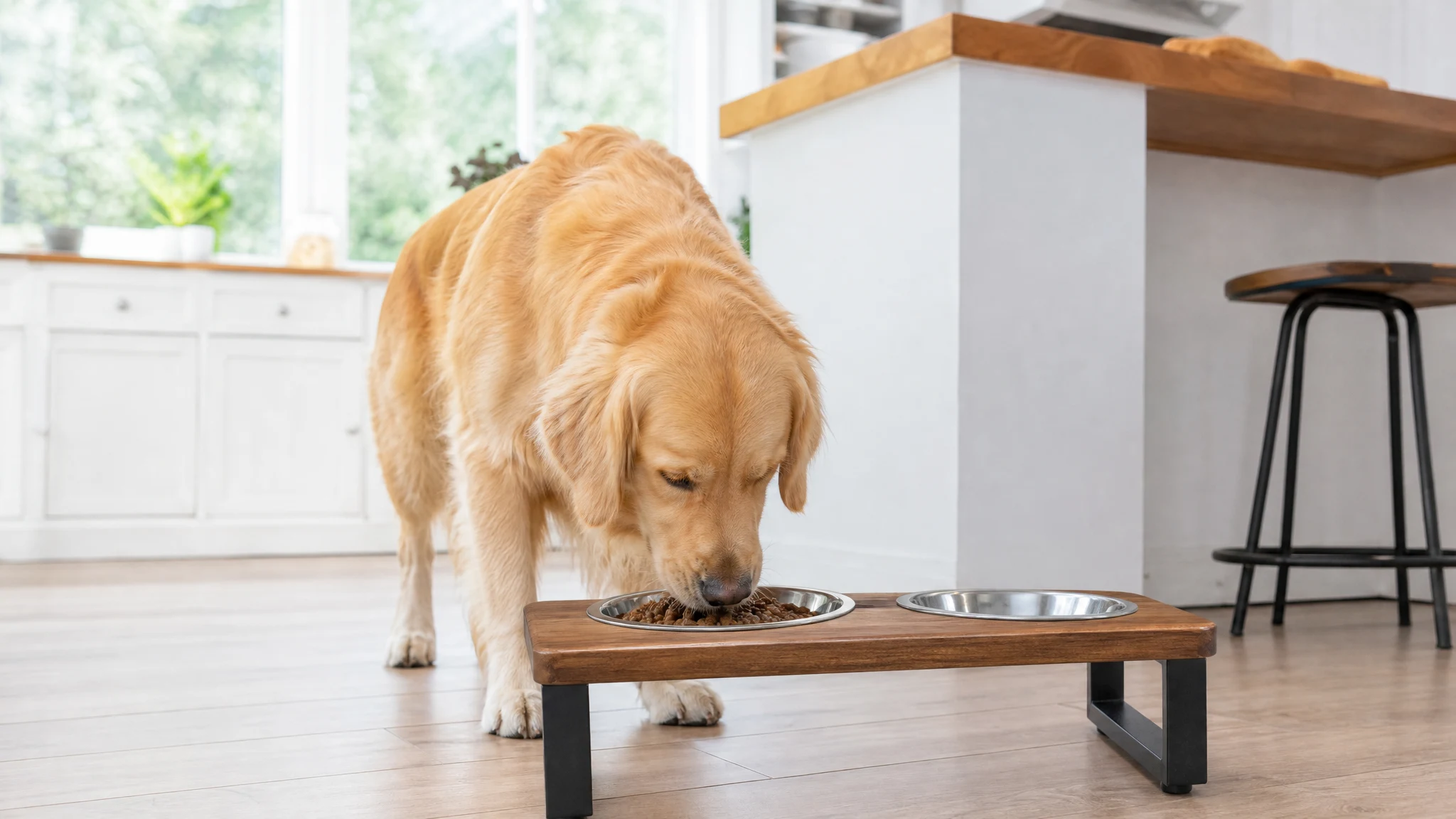
General nutrition information compiled from product labels and published sources, not veterinary advice. Your veterinarian is the right person to choose a diet for your dog, especially one with a health condition.
Choosing retriever puppy food is mostly a label-reading job. Golden Retrievers grow fast, and the American Kennel Club (AKC) notes that some Goldens can become overweight, so both what you pour and how much you pour matter.
This guide walks through the process in order: pick a food, check its label, set a starting portion, split it into meals, and adjust by watching your puppy. We compared label data from the brands named below. We did not run feeding trials or taste tests, and we are not ranking foods.
What You Will Need
- The bag or can of the puppy food you are considering, or its brand page, so you can read the full label.
- A dry measuring cup or a kitchen scale. Scoops that come with bags are not standardized.
- Your puppy's current weight, from a home scale or your vet's office.
- A notebook or phone note to log weight, portions and treats.
- Your veterinarian's contact details, since the final call on amounts for an individual puppy is theirs.
Step 1: Know the Size Your Puppy Is Growing Into
The AKC breed page lists adult Golden Retrievers at 65 to 75 pounds for males and 55 to 65 pounds for females. The AKC gives a life expectancy of 10 to 12 years. Royal Canin describes Goldens as a large breed.
That matters because a large dog's growth is a long project. Royal Canin feeds its Golden Retriever puppy formula up to 15 months. Hill's labels its large breed puppy food for puppies that will be over 55 pounds as adults, up to 18 months. Those are manufacturer age ranges, not a universal rule, so ask your vet when to switch to an adult food.
Step 2: Choose a Food Made for Growing Large Dogs
Cornell University's Riney Canine Health Center advises feeding diets formulated for large breeds while puppies are growing. It also says hip dysplasia is genetic but is modified by nutrition and growth rate. Overfeeding and rapid growth can make it worse in predisposed puppies.
Look for the nutritional adequacy statement, usually in small print near the ingredient list. Under the model wording used in state feed rules such as Kentucky's 12 KAR 3:039, a food that claims "growth" or "all life stages" must add one of two phrases:
- "including growth of large size dogs (70 lb. or more as an adult)", or
- "except for growth of large size dogs (70 lb. or more as an adult)".
Since the AKC lists male Goldens up to 75 pounds, many sit near that 70 pound line. A food carrying the "including" phrase, or one made specifically for large breed puppies, is the more sensible fit.
What the label data shows for a few options
| Food | Adequacy statement | First ingredients | Calories |
|---|---|---|---|
| Royal Canin Breed Health Nutrition Golden Retriever Puppy (dry) | We found no adequacy statement on the brand page, so check the bag or ask the brand | Chicken by-product meal, corn, chicken fat, wheat, brewers rice | 339 kcal ME per cup |
| Hill's Science Diet Puppy Large Breed Chicken & Brown Rice (dry) | Feeding tests substantiate it for growing puppies. No large-size phrase is quoted | Chicken, brown rice, whole grain oats, chicken meal, cracked pearled barley | 391 kcal per cup |
| JustFoodForDogs Chicken & Rice (fresh frozen) | All life stages, including growth of large size dogs (70 lbs. or more as an adult) | Chicken, long-grain white rice, long-grain brown rice, carrots, kale | 43 kcal ME per ounce |
Royal Canin lists a guaranteed analysis of at least 27% protein and 14% fat for its puppy formula, with fiber at most 5.4%. Hill's publishes dry-matter averages instead of guaranteed minimums, giving 26.3% protein and 15.4% fat on a dry-matter basis, with calcium at 1.16%. Those two sets of numbers are not directly comparable, so do not line them up as if they were.
JustFoodForDogs lists its numbers as fed, with a moisture maximum of 72%, which is why they look so much lower. Calorie density varies widely between dry and fresh foods, so a cup of one is not a cup of another. For full details, see the Royal Canin Golden Retriever Puppy page, the Hill's large breed puppy page and the JustFoodForDogs Chicken & Rice page.
Step 3: Read the Rest of the Label
After the adequacy statement, check these in order:
- Ingredient order. Ingredients are listed by weight, so the first five tell you the base of the recipe.
- Guaranteed analysis or dry-matter figures. Note which basis the brand uses.
- Calories per cup. You need this number to judge portions.
- The feeding guide. Treat it as a starting point, not a prescription.
A word on grain-free and DCM. The U.S. FDA has received reports of diet-associated dilated cardiomyopathy (DCM): 1,382 reports from January 1, 2014 to November 1, 2022. FDA says reports involve both grain-free and grain-containing diets, and that report counts alone do not establish a causal relationship. It has not requested recalls.
The Golden Retriever Club of America says Goldens appear particularly susceptible to taurine deficiency, and the FDA notes a reporting bias for Goldens in DCM reports. No food choice can promise protection. Ask your vet about your puppy's diet and heart health.
Step 4: Set a Starting Portion
Start with the feeding table on the food you chose, matched to your puppy's current weight and age. Then confirm the calories per cup, since the table is built on them. Our Golden Retriever feeding chart by age walks through how amounts shift as a puppy grows.
Brand guides are blunt about their limits. Hill's tells owners to adjust amounts as necessary to maintain optimal weight and to ask a veterinarian if unsure. Activity level matters too. A puppy who spends the day on long play sessions may need more than a calmer one, and a spayed or neutered puppy may need less. Your vet can judge that for your dog.
Weigh out each portion rather than eyeballing the scoop. Many owners overshoot by a quarter cup or more without noticing.
Step 5: Split the Day Into Meals
Royal Canin recommends feeding its Golden Retriever formulas in 2 to 4 equal portions per day. A common pattern is to start with more, smaller meals for a very young puppy and move to fewer as your vet advises. Keep mealtimes at roughly the same hours each day.
Pick up the bowl after about 15 to 20 minutes. Free feeding makes it hard to know how much your puppy actually ate, which makes weight management harder.
Step 6: Check Body Condition and Adjust
Cornell advises keeping puppies at higher orthopedic risk trim while they grow, without cutting essential nutrients. Trim does not mean thin or underfed.
- You should be able to feel the ribs under a light covering of flesh.
- Looking from above, there should be a visible waist behind the ribs.
- Weigh your puppy regularly and log it. Share the trend with your vet at checkups.
If your puppy is gaining faster than your vet likes, reduce the portion a little and recheck in a couple of weeks, rather than making a big cut. Do not drop below the nutrients a growing puppy needs.
Step 7: Change Foods Slowly
Whenever you switch foods, including the move from puppy to adult food, mix the new food in with the old over about a week. Increase the new share a little every day or two. If you see ongoing loose stools, vomiting or loss of appetite, stop and call your vet.
Tips and Common Mistakes
- Counting treats as zero. Training treats add calories. If you use a lot of them, trim meals slightly.
- Adding supplements. Cornell advises not supplementing growing puppies with calcium or vitamin D. Ask your vet before adding anything.
- Feeding an adult food too early. Adult formulas are built for maintenance, not growth. Ask your vet when to switch.
- Choosing by the front of the bag. Marketing words like "natural" or "premium" are not nutrition data. The adequacy statement and the analysis are.
- Assuming a breed formula is a medical diet. A Golden Retriever formula is a regular food. Prescription diets are only something a veterinarian prescribes.
- Letting the cup drift. A scoop of fresh kibble is easy to over-fill. Re-measure now and then.
- Ignoring a health condition. If your puppy has a medical issue, confirm every amount with your vet.
What to Expect
With a complete and balanced food that suits large puppies, measured portions and regular weigh-ins, many owners find their puppy grows steadily and keeps a healthy build. Results vary by dog. Genetics, activity and health all play a part.
Diet is one factor among several. The Golden Retriever Club of America recommends screening for hip dysplasia, elbow dysplasia, inherited eye disease, heart disease and NCL, and no food can prevent or treat those conditions. Your vet decides what is right for an individual dog.
Sources
- American Kennel Club, Golden Retriever breed page
- Cornell University College of Veterinary Medicine, Canine hip dysplasia
- Cornell University College of Veterinary Medicine, Elbow dysplasia
- Kentucky Agricultural Experiment Station, 12 KAR 3:039 Nutritional adequacy
- U.S. FDA, Investigation into potential link between certain diets and canine DCM
- U.S. FDA, Questions and Answers on non-hereditary DCM in dogs
- Golden Retriever Club of America, Diet-Associated Heart Disease in Golden Retrievers
- Golden Retriever Club of America, Health Statement (March 2020)
- Royal Canin, Golden Retriever Puppy
- Hill's Science Diet, Puppy Large Breed Chicken & Brown Rice
- JustFoodForDogs, Chicken & Rice Recipe